


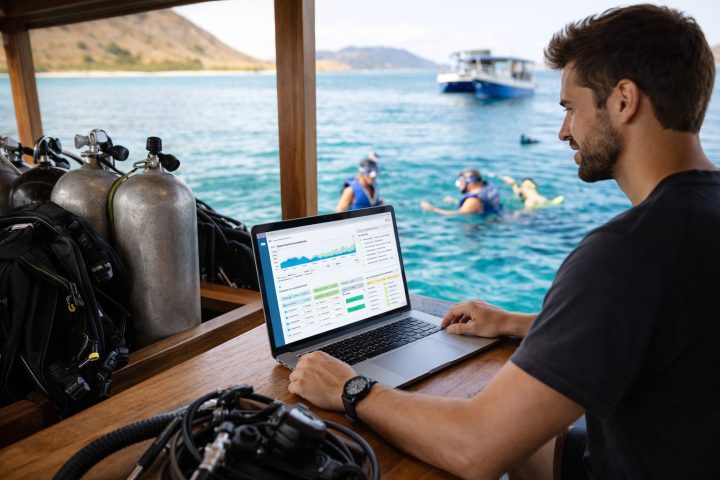
If your goal is to find the best places for scubadiving in Bali, the most helpful advice is not a list of “top ten” names; it’s understanding how Bali’s coastline behaves, how conditions change through the day, and how operators design safe, enjoyable water time for mixed-ability guests. That is where good hospitality and sound systems quietly do their work.
I manage a diving centre in Bali and have spent more than 15 years in Indonesia’s diving and hospitality operations, including the software side of the industry, booking flows, guest communications, scheduling, equipment tracking, and the small details that prevent a day on the water from turning stressful. This article is for dive centre owners and B2B readers who build tools for the sector. The focus is non-commercial and practical: how to think about snorkelling “places” as part of an experience that must be delivered consistently, safely, and profitably.


Bali isn’t one snorkelling destination, it’s a network of micro-conditions
Bali works best when we stop treating it as a single product. Sea state, currents, and visibility can vary widely depending on which side of the island you are on, the season, and even the time of day. That matters because snorkelling guests often have less tolerance for discomfort than divers: a bit of chop, a strong current, or confusing instructions can sour the experience quickly.
From an operator’s perspective, “best” snorkelling in Bali is not simply where the reef looks nicest on a calm day. It’s where you can reliably deliver:
- Easy water entry and exit
- Predictable supervision and safe boundaries
- Clear visibility windows in the morning or around the tide
- A plan B if conditions turn
This is why experienced teams talk about “the day’s site” rather than “the site”. The sea decides what’s truly best.
What makes snorkelling feel premium without being expensive
Snorkelling guests judge quality through comfort and clarity. They notice:
- Whether they were briefed properly before entering
- Whether someone is actively watching the group
- Whether the kit fits and doesn’t leak
- Whether they understood where they could and couldn’t go
- Whether the exit was managed calmly
None of those requires luxury. They need a process.
For dive centre owners, snorkelling is often treated as a “lighter” product than diving. Operationally, it can be the opposite: a snorkelling group may include nervous swimmers, children, first-time travellers, and people who underestimate the effects of sun exposure. The service design must be strong.
How snorkelling and diving operations overlap in Bali
Many Bali businesses run both snorkelling and diving, and that’s where scheduling discipline becomes crucial. A high-quality snorkelling operation benefits from the same backbone as scuba diving in Bali, Indonesia: briefings, equipment control, staff assignments, boat readiness, and guest messaging.
The overlap is functional for operators because it allows shared infrastructure. But it also creates a common failure point: a single late departure can cascade across multiple trips and guest groups.
This is where hospitality software becomes more than admin. It becomes operational control.
The operator’s fundamental problem: mixed groups and mixed expectations
Bali attracts mixed groups constantly: one person wants to dive, another wants to snorkel, and someone else wants a beach day with a short swim. If you can’t handle mixed expectations, you lose the group booking, or you end up with disappointed guests.
Strong operators structure mixed days with:
- Clear activity tracks and meeting points
- Transparent timings (especially pick-ups and return windows)
- Comfort options for non-swimmers (floatation, guided zones)
- A single point of contact for the group lead
From a business standpoint, mixed-group design is revenue protection. From a guest standpoint, it’s the difference between “Bali was chaotic” and “Bali was easy.”
What “best snorkeling in Bali” means to different guest types
The phrase “best snorkeling in Bali” is a single search query but represents multiple guest intents. Operators do better when they segment quickly:
- First-timers want calm water, easy entries, and reassurance.
- Families want safety boundaries, attentive supervision, and shorter sessions.
- Confident swimmers want variety and the chance to see more.
- Underwater photographers want visibility, timing, and unhurried water time.
A site that delights one segment can disappoint another. The key is not to oversell; it’s to match.
For software builders, segmentation is not just marketing metadata. It’s operational logic that can drive safer planning: group composition, guide ratios, equipment allocation, and contingency options.
The hidden differentiator: pre-arrival communication
In Bali, much of the guest experience is decided before the guest arrives. A short, well-timed message can prevent the most common issues:
- Guests arriving without swimwear or towels
- Guests are surprised by early pick-ups.
- Guests do not understand the risk of seasickness.
- Guests are not disclosing poor swimming confidence.
- Guests underestimating sun exposure
The message tone matters. The best communications are friendly, simple, and confidence-building—not heavy-handed.
From a systems perspective, this is where automation helps without dehumanising: a well-crafted template delivered at the right time reduces inbound calls, reduces confusion, and makes staff look effortlessly organised.
On-the-day execution: checklists beat heroics
Water operations fail in predictable ways: missing masks, late boats, unclear briefings, and staff stretched thin. The solution is rarely “work harder”. It’s “work repeatably.”
Operational best practice looks like:
- A pre-departure kit check (sizes, spares, defog, fins)
- A brief, standardised safety talk that guests actually understand
- A clear supervision plan (who watches, who guides, who counts)
- A simple buddy or group system, even for snorkellers
- A documented weather threshold that triggers a site change
For dive centre owners, this is a training and culture issue. For software builders, it’s a workflow issue: can the day plan be visible, shared, and updated without WhatsApp chaos?
Where liveaboards fit into the Bali conversation
Bali is often used as a gateway: travellers arrive for a short stay, then continue to other regions by boat or onward flights. In that broader trip pattern, liveaboards become relevant—especially for divers who want multi-day access rather than day trips.
Mentioning Neptune One liveaboard here isn’t about promotion; it illustrates a category shift that many Bali operators see in their guests. Some travellers start with snorkelling to build comfort, progress to introductory dives, and then ask about multi-day boat-based itineraries. The practical lesson for operators and software teams is to support progression: guest profiles should capture interest, comfort level, and next-step intent so staff can advise responsibly rather than guessing.
From a business perspective, progression pathways increase lifetime value and reduce churn. From a safety perspective, they encourage divers to develop skills in steps rather than rushing.
What dive software should prioritise for snorkelling products
Most systems in the diving world are built around scuba courses, certifications, and dive logs. Snorkelling is often treated as an afterthought. That’s a missed opportunity, because snorkelling volume is high and the operational risk can be meaningful.
Software that supports snorkelling well typically includes:
- Fast booking with apparent inclusions and timing
- Guest readiness questions (swimming confidence, medical flags, children)
- Equipment assignment and sizing notes
- Staff rostering and guide ratios linked to group composition
- Automated pre-trip messaging (what to bring, pick-up, sun, and seasickness)
- Simple incident logging and feedback capture
These aren’t “nice-to-haves”; they reduce operational stress and improve consistency.
Closing thought: Bali’s best water days are engineered
Bali can deliver extraordinary moments in shallow water colour, life, and that unique feeling of stepping into a different world. But the quality guests remember is shaped by the operation: the clarity of information, the calmness of supervision, and the smoothness of the day from pick-up to return.
For dive centre owners, the takeaway is that snorkelling deserves the same process discipline as diving. For B2B readers building tools, the opportunity is to design for real-life variability, weather shifts, mixed groups, and human needs so operators can consistently deliver safe, enjoyable experiences.
Because when a guest says they managed to find the best places for snorkeling in Bali, what they usually mean is simpler: the day ran smoothly, they felt safe, and the ocean gave them a story worth retelling.