

You trust dozens of outside apps and suppliers with sensitive data. They trust dozens more. Your risk is only as strong as the weakest link in that chain.
A 2025 Ponemon study found that 98 percent of companies work with at least one partner that has already been breached. Regulators now expect continuous oversight, not a once-a-year checkbox.
Yet many teams still rely on spreadsheets and email attachments, then hope nothing changes between audits. That manual grind slows deals and leaves gaps attackers can exploit.
The good news is that a new wave of AI-driven third-party risk management platforms can cut review time, surface live issues, and produce clearer, more explainable risk scores. This guide ranks five leaders for 2026, breaks down exactly how we scored them, and helps you choose the right fit.
Next, here’s the scorecard we used to keep the rankings grounded in evidence, not buzzwords.
How we built a trustworthy scorecard
“Best” lists are only useful when the scoring rules are clear. Otherwise, you get a parade of logos with no way to compare them.
We started by scanning more than 20 third-party risk platforms that were released or materially updated since January 2024. We cut anything that relied on rule-based logic posing as AI, or couldn’t point to paying customers. The five tools that remained earned their spots through evidence, not press releases.
From there, we scored each platform across six weighted pillars that map to real buying pain points:
- AI depth and transparency (20 percent). Does AI do more than auto-fill fields? Can you trace each risk call back to concrete evidence?
- Continuous monitoring and integrations (20 percent). Hourly alerts matter only when they flow into the tools your team already runs.
- Risk coverage and control libraries (15 percent). Cyber, privacy, financial stability, and ESG coverage reduces blind spots.
- Workflow and user experience (15 percent). Strong vendor portals and low-friction setup save time on both sides of the review.
- Reporting and analytics (10 percent). Dashboards and exports should make it easy to brief leadership and auditors.
- Pricing to value and scalability (20 percent). ROI needs to pencil out for small teams, while costs stay predictable as vendor counts grow.
Each pillar received a score from one to five. We multiplied by the weight and summed the results for an overall score out of 100. The totals determined the rank order. Our commentary explains the trade-offs behind the numbers.
Finally, we pressure-tested scores against peer reviews, public case studies, and live demos. When a feature under-performed in practice, the score dropped.
With the framework set, here’s the top pick for 2026.
1. Vanta: AI-assisted third-party risk management
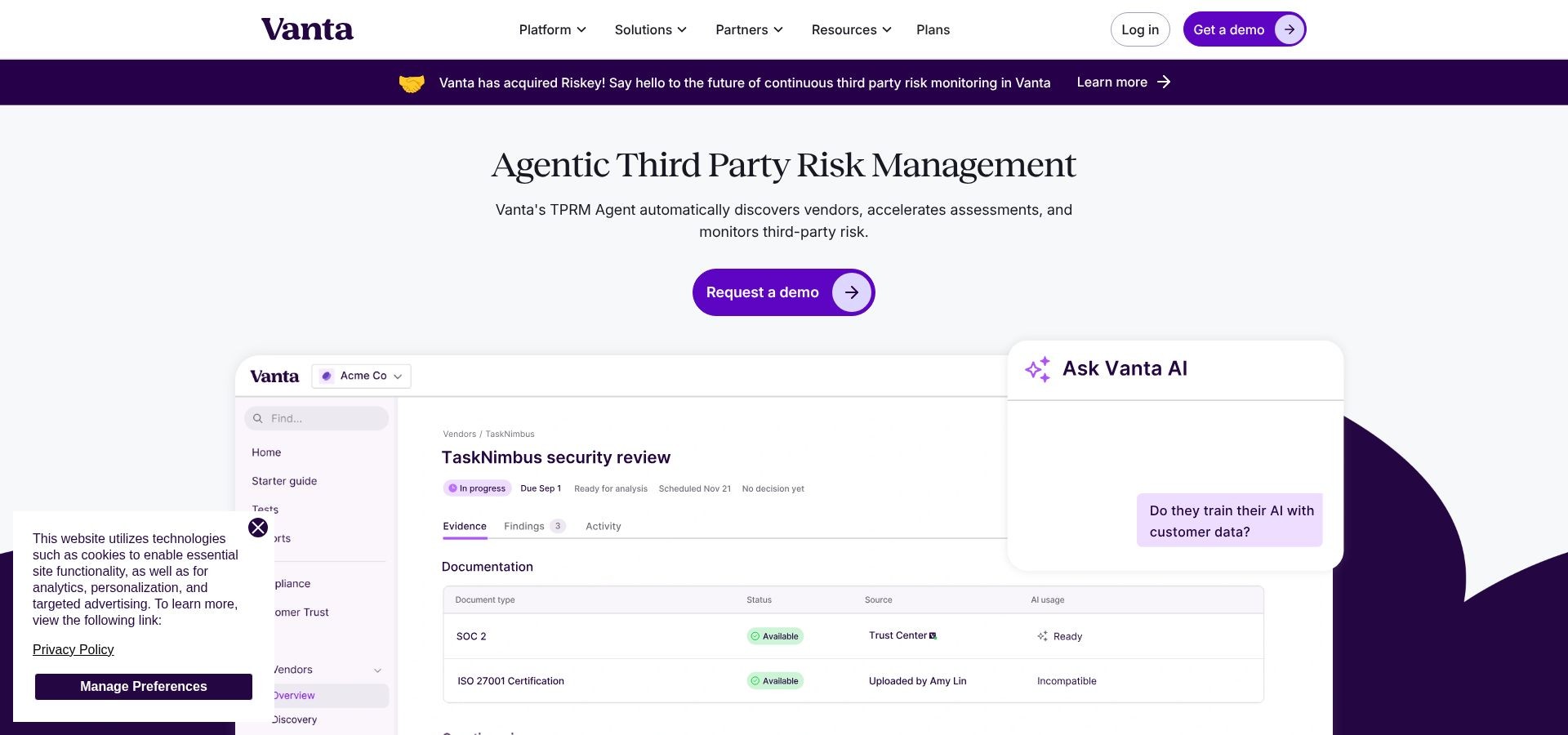
Vanta built its reputation by automating internal compliance work for frameworks like SOC 2 and ISO 27001. In 2023, it applied that same automation to vendor reviews, turning what is usually a slow questionnaire cycle into a simple, two-click workflow.
Import your vendor list and Vanta’s AI agent parses questionnaire responses, policy files, and SOC 2 reports. It flags what looks out of bounds, points to the exact clause, and suggests follow-up questions. Vanta highlights reports of cutting assessment time by up to fifty percent on its product page. Vanta’s vendor risk management module reports cutting assessment time by up to fifty percent.
Stand-out AI capabilities
Plenty of tools claim machine learning. Vanta’s strongest differentiator is explainability. When the agent calls out a missing encryption control, it links directly to the relevant section in the vendor’s uploaded policy. That trail matters when procurement asks “why,” or when an auditor wants evidence behind a risk decision.
Vanta also keeps watch after initial approval. If a vendor’s SOC 2 expires, or an Okta integration surfaces new shadow-IT apps, you get an alert instead of discovering the issue at renewal time.
Where it shines
Vanta is quick to deploy. Many teams can roll it out in days because it plugs into the same control and evidence workflows they already use for internal compliance.
The vendor experience is also straightforward. A simple portal and auto-prefill hints reduce back-and-forth, which can shorten response cycles and cut down on escalation emails.
Watch-outs
Vanta’s external telemetry is thinner than a pure-play rating service. If you need deeper threat intelligence, you may still bring in a BitSight or SecurityScorecard score.
The third-party module is also relatively young. Areas like detailed financial risk and contract analytics are still on the roadmap.
Best fit
Vanta is a strong fit if you already use it for internal audits, or you want one system that covers both internal compliance and third-party reviews. It works especially well for fast-growing tech firms through mid-market enterprises that want speed without sacrificing defensibility.
Pricing snapshot
Pricing scales by company size and vendor count. Most customers we interviewed keep it under six figures, and they view that as strong value compared with legacy GRC suites that can take months of consulting just to get questionnaires running.
In short, Vanta pairs speed with substance, and gives lean teams a practical way to run vendor reviews with less manual work and clearer evidence.
2. BitSight: Cyber risk intelligence for the whole supply chain
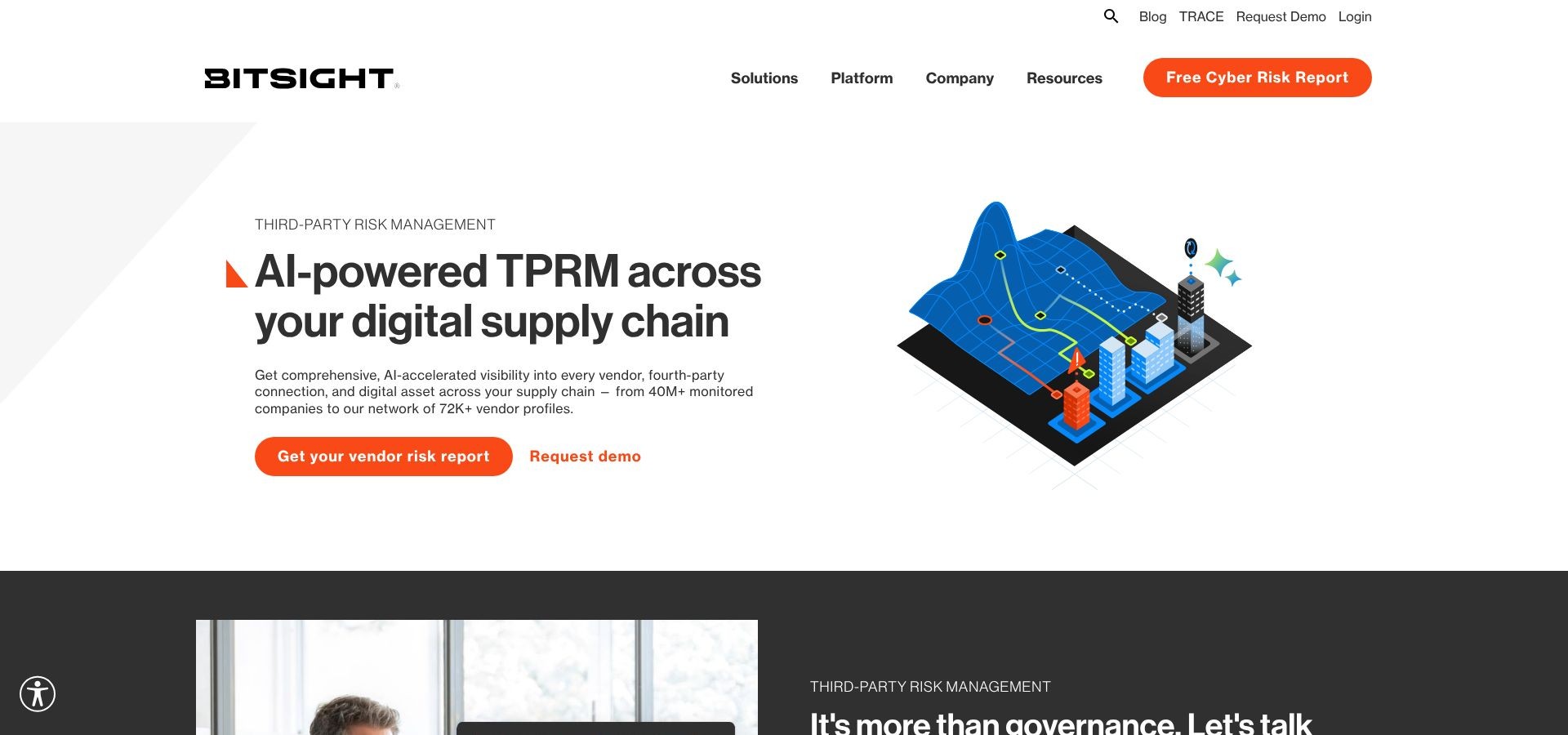
BitSight helped define the external security-ratings category, and it still operates at a scale that newer entrants struggle to match. Its scanning engines monitor more than forty million companies every day. That telemetry feeds machine-learning models that connect specific security signals to real breach outcomes, so a score drop is not just noise. It is designed to indicate increased risk.
Over the past year, BitSight has layered large-language models on top of that data. A flagship feature, Instant Insights, can parse a fifty-page SOC 2 report in seconds and summarize red flags in plain English. That shift is practical. Your team spends less time reading and more time deciding what to do next.
Stand-out AI capabilities
- Generative document analysis. Upload audit reports, certificates, or policies, and the model extracts control gaps, maps them to NIST or ISO frameworks, and cites the relevant paragraph as evidence.
- Fourth-party mapping. BitSight cross-links DNS, SSL, and cloud artifacts to surface your vendors’ vendors, which helps expose downstream concentration risk during incident response.
- Predictive breach scoring. The platform uses historical loss data to forecast the likelihood of a vendor experiencing a cyber event in the next twelve months, which gives risk committees a clearer numeric signal.
Where it shines
BitSight delivers continuous, outside-in visibility at enterprise scale. Daily score changes can flow into systems like ServiceNow or Archer, updating risk registers automatically and triggering conditional controls, such as purchase-order holds. Executives get simple letter grades, and analysts can drill down to port-level evidence when they need to validate the “why” behind a score.
The data also supports benchmarking. If a critical SaaS partner sits in the bottom quartile versus peers, you have concrete leverage to push for remediation or revisit contract terms.
Watch-outs
BitSight is deep on technical cyber risk, not broad across every risk domain. Privacy posture, financial stability, and ESG typically still require internal questionnaires or specialized third-party feeds.
Budget is another constraint. Enterprise licenses often reach six figures, which can be hard to justify for smaller organizations unless continuous monitoring is a regulatory expectation.
Vendors also sometimes dispute ratings. BitSight offers an evidence portal to resolve disagreements, but that creates an extra workflow step.
Best fit
BitSight fits global banks, insurers, and Fortune 500 organizations with thousands of suppliers that need always-on cyber oversight. If cyber hygiene is a board-level priority and your budget supports continuous monitoring, BitSight is a strong early-warning layer.
Pricing snapshot
BitSight sells tiered annual contracts based on the number of vendors monitored, with optional add-ons such as fourth-party discovery. Expect an executive-level price, balanced by faster board reporting and fewer surprises.
BitSight’s strongest value is the outside-in view. Pair it with an internal questionnaire engine and you cover both sides of supplier cyber risk.
3. Prevalent: the Swiss Army knife of TPRM
Prevalent has been in vendor risk management long enough to build real depth. That shows up in the practical details: more than 800 ready-made questionnaires, workflow builders that can mirror internal policy, and reporting that stands up to auditors who want a complete trail.
Last year, Prevalent added generative AI across that mature foundation. The result is less manual review and faster turnaround, without stripping out the controls that regulated teams rely on.
Stand-out AI capabilities
Prevalent’s Questionnaire Analyzer reviews vendor responses as they come in, scores controls automatically, and flags answers that exceed your risk tolerance. That reduces the end-of-cycle scramble where everything piles up for a single review session.
It can also suggest answers for vendors, which helps cut down repetitive work across customers and reduces survey fatigue.
On the monitoring side, Prevalent pulls live feeds for cyber, financial, and dark-web chatter. When a supplier’s credit rating drops or credential dumps surface, the risk score updates without waiting for an annual reassessment.
Where it shines
Coverage is the main reason buyers choose Prevalent. It brings cyber, privacy, financial health, ESG, and operational resilience into one console, which makes it easier to demonstrate diligence across risk domains in a single audit narrative.
The workflow engine is another strength. You can turn policy into routing logic; for example, if inherent risk is high and the vendor touches customer PII, route to legal and request a Data Processing Agreement. That kind of conditional automation keeps decisions consistent across teams and across time.
Watch-outs
Prevalent’s depth can come with setup overhead. Admins often spend weeks tuning templates, approval chains, and scoring to match how their organization actually buys and reviews vendors.
User experience is also mixed. Risk teams tend to value the completeness, while some vendors find the portal more demanding than newer, lighter tools.
Costs scale with ambition. As you add continuous monitoring, consulting support, and additional modules, the total price can climb quickly.
Best fit
Prevalent fits regulated organizations that need to document the full vendor lifecycle and prove control coverage across multiple domains. It is especially relevant in industries like healthcare, banking, and pharma, where “good enough” questionnaires rarely survive audit scrutiny.
Pricing snapshot
Prevalent offers modular SaaS and private-cloud packages priced by vendor count and feature set. Mid-six-figure annual totals are common for Fortune-level rollouts, while midsized teams can start smaller and expand over time.
Prevalent is not the lightest option on this list. If you want one system of record for comprehensive TPRM, it is one of the most complete platforms to evaluate.
4. UpGuard: bridging outside-in scans with inside evidence
UpGuard started with security ratings and attack-surface scanning for companies’ own infrastructure. It later aimed those same sensors at third parties and paired the findings with a straightforward questionnaire workflow. That combination makes it easier to compare what a vendor documents in policies and questionnaires with what UpGuard can observe from the outside.
Stand-out AI capabilities
UpGuard uses natural-language analysis to review questionnaire responses, contracts, and policy documents you collect. It flags contradictions, highlights missing controls, and drafts follow-up questions so your team spends less time writing and more time verifying.
On the external side, its scanners look for exposed databases, expired certificates, leaked credentials, and DNS errors. Machine-learning models score issues and roll them into an A–F letter grade that is easy to share with non-technical stakeholders.
Where it shines
Speed is a core advantage. Enter a vendor’s domain and UpGuard can return a risk grade within minutes. Teams often find quick wins, like a forgotten subdomain or a stale certificate, before the first questionnaire is even completed.
UpGuard is also easy to operate day to day. The interface translates scan results into plain language, and integrations can push alerts into tools like Slack or Jira so remediation fits existing workflows.
Watch-outs
UpGuard’s control library is slimmer than platforms like Prevalent. If your program requires a long, privacy-heavy questionnaire out of the box, such as a 200-question survey, you should expect to build it yourself.
Enterprises with thousands of suppliers may also find the standard workflows limiting. Complex approvals and bulk segmentation can require workarounds.
Best fit
UpGuard is a strong match for mid-market tech, fintech, and SaaS teams that want fast, visual cyber insight plus lightweight vendor due diligence. A lean security team can get continuous monitoring without heavy configuration.
Pricing snapshot
UpGuard offers tiered SaaS subscriptions based on the number of monitored vendors. Entry plans cost a fraction of legacy GRC suites, and you can add deeper functionality as your vendor portfolio grows.
UpGuard proves that real-time supplier security signals do not require a six-figure platform and months of setup.
5. RiskImmune: instant assessments for lean teams
RiskImmune is a newer platform built around one core idea: run a credible vendor assessment in minutes, not weeks. Founded in 2016 and incubated in TechStars, it combines automated scanning with an optional analyst pod that functions like a fractional risk team. That hybrid model is especially useful when vendor volume grows faster than your headcount.
Stand-out AI capabilities
Start with a vendor’s domain and RiskImmune’s crawler pulls open-source intelligence, breach databases, and compliance registries. Based on what it finds, the platform generates a tailored questionnaire that focuses on uncovered gaps. Vendors answer fewer, sharper questions, which can improve response rates and reduce questionnaire fatigue.
RiskImmune also maps findings to common frameworks, including ISO 27001 and EU DORA, so you can produce a structured report without stitching together evidence by hand.
Where it shines
Speed and simplicity are the point. Teams that need to onboard a new payment provider or marketing SaaS can upload the contract, run the scan, and make a decision quickly. When edge cases show up, the analyst pod can step in to translate results into board-level language or chase vendors when your internal team is swamped.
Pricing is another draw. RiskImmune positions itself with transparent annual fees that come in below many enterprise-focused tools.
Watch-outs
RiskImmune does not yet have the customer community or integration catalog of the higher-ranked platforms. Dashboards are improving, but they remain more basic than deeper, auditor-heavy tools.
Some large, regulated organizations also hesitate to outsource any part of vendor risk analysis. RiskImmune holds SOC 2 certification and uses data-segmented analyst access, but procurement teams may still push hard on trust and process controls.
Best fit
RiskImmune is a practical choice for high-growth startups, regional banks, and midsize healthcare organizations that need to stand up a credible TPRM program quickly, without hiring a full team of analysts.
Pricing snapshot
Software-only entry packages start at $41 per month. Analyst support is available à la carte as vendor volume or regulatory pressure increases.
RiskImmune proves there is room for faster, leaner approaches in a market dominated by incumbents. If speed and affordability matter more than brand recognition, it is worth a look.
Choosing the right solution: key considerations
Tools do not close risk gaps on their own. They strengthen, or expose, the processes you already run. Before you sign, sanity-check your shortlist against four questions.
What risks does your board actually care about?
If ransomware is the concern, prioritize continuous cyber telemetry and breach-predictive scoring. In that case, BitSight or UpGuard often rise quickly. If audits center on privacy clauses and ESG metrics, broader platforms like Prevalent or Vanta tend to score better.
How much internal capacity can you realistically support?
A global bank with a dedicated vendor risk team can run a heavyweight tool with granular workflows. A two-person DevSecOps team usually needs faster time to value and less admin overhead. That difference often decides between Prevalent and RiskImmune before price becomes the deciding factor.
Where will scores and alerts live day to day?
Vendor risk data only matters if it reaches the right people at the right time. Confirm the platform can push alerts into ServiceNow, Slack, or Jira, wherever your team already works. Open APIs beat one-off CSV exports.
Can the platform explain its AI decisions under pressure?
Ask for a live demo of an assessment that goes wrong, a false positive, a disputed score, or a missed control. The best platforms can trace every red flag back to a specific policy line or evidence artifact. If the explanation stays vague, keep digging until you see the source.
A quick checklist for your demo call:
- Show how the AI flags weak encryption, and point to the source evidence.
- Demonstrate a score change triggered by a new vulnerability disclosure.
- Export a board-ready PDF that explains both findings in plain language.
Cover those points and you will pick a platform that matches your risk appetite, team capacity, and integration needs, not just a dashboard that looks good in a sales demo.
The road ahead: where AI-driven TPRM goes next
The five platforms above show what AI-driven third-party risk management looks like today. The next wave will push the category further in three ways.
First, AI transparency will shift from “nice to have” to baseline. Frameworks like the EU AI Act and NIST AI RMF emphasize explainable outcomes. In practice, that means risk tools will need to show not only what they flagged, but also model confidence, training-data sources, and version history. Buyers will increasingly expect the ability to set thresholds, retrain models on their own evidence, and generate reports with a provenance log that auditors can validate quickly.
Second, AI transparency will shift from “nice to have” to baseline. Early pilots already pull real-time indicators from financial filings, news sentiment, and workplace-safety citations. The direction is clear: monitoring engines that spot a negative earnings alert for a key logistics provider, model downstream impact on delivery SLAs, and trigger a contingency review before the board asks.
Third, autonomous remediation will move into the workflow. Today’s tools raise flags. Tomorrow’s tools will take controlled action, for example pausing a vendor’s SSO access when breach prediction spikes, or holding back payments through your ERP until proof of patching arrives. Humans stay in the loop, but the loop shrinks from days to minutes.
What this means for buyers is straightforward. Evaluate more than feature checklists. Ask how the platform learns over time, what governance controls exist around that learning, and how quickly the roadmap ships improvements. The risk surface will keep expanding. Your program’s advantage will be how fast it can adapt.

